
Press|
[Namsan-gil Stroll] The Future of K-Art, Learning from Munch
The Asia Business Daily
A Case of How One Artist Changed an Era and a Nation
K-Art as an 'Everlasting Asset' Combined with National Strategy

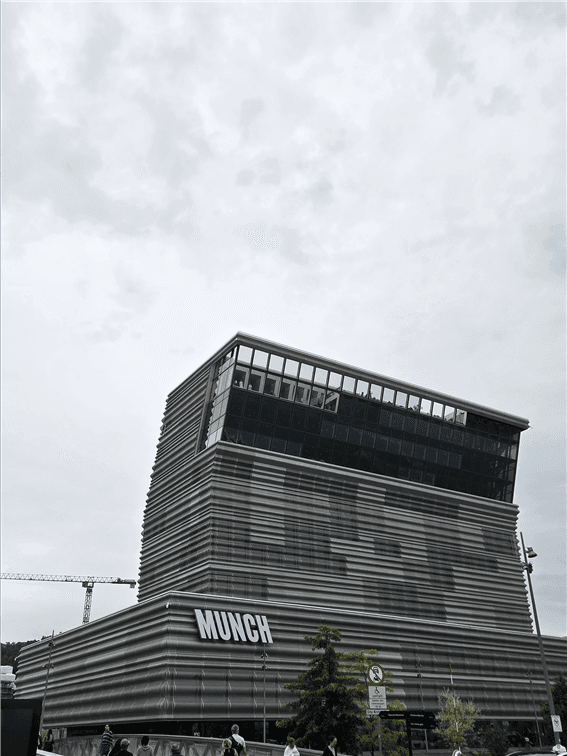
The Munch Museum, which relocated and opened in Oslo, Norway in 2021, has seen a continuous stream of international art lovers since its opening. It first opened in 1963 in Oslo's Tøyen district and was later rebuilt in Bjørvika, opening its new building on October 22, 2021. The museum has become more than just an exhibition space; it is a landmark symbolizing Norway's cultural identity and has established itself as a must-visit destination for those in Oslo today.
What is noteworthy is that Norway was long considered one of the poorest countries in Northern Europe. Until the 1930s, Norway had a relatively underdeveloped economic structure compared to Sweden, Denmark, and Finland, possessing a weak industrial base and a low-income structure reliant mainly on agriculture, fishing, and forestry. During this period, the Norwegian artist Edvard Munch was active, but the nation lacked the capacity to brand him internationally. Later, in the late 20th century, Norway, which built an economic foundation through the oil industry, formulated a strategy to expand this into culture. In this process, by highlighting the master of Norwegian art history, Munch, as a global icon, the Munch Museum plays a crucial role in strengthening the national brand. Munch has transcended the level of an individual artist to represent 'Norwegian culture itself.'
Looking back at Korea's situation, we have already achieved success in K-pop, K-dramas, and K-literature, which received global attention through the Nobel Prize. However, art, or K-Art, has yet to fully establish itself in terms of global popularity or influence. While works by Korean artists are being collected in major overseas museums and transactions are actively taking place at international art fairs, there is still a long way to go when considering cultural ripple effect. Nevertheless, its potential is greater than any other cultural domain.
Recently, while preparing exhibitions for five Korean female artists—Park Rae-hyun, Cheon Kyung-ja, Bang Hye-ja, Yoon Seok-nam, and Ryu Min-ja—I was able to directly confirm the potential for K-Art's popularity and influence. Even during a time when there were additional social constraints on Korean artists, especially women, they continuously created their own narratives, experiencing countless moments of light and darkness. As they navigated the dynamic and dramatic events of modern and contemporary Korean history—from the Korean Empire, Japanese colonial rule, liberation, the Korean War, to the Republic of Korea—the condition of dual minority—woman and artist—became, instead, a fundamental characteristic shaping their work. Works utilizing Korean materials, such as Hanji paper and damchae techniques, hold the texture and spirituality of time, giving them irreplaceable value in the international art market. The power of Korean art lies precisely in this 'combination of uniqueness and universality.' The originality derived from Korean materials and techniques, coupled with the narrative power that touches universal human emotions, is a language that resonates anywhere in the world.
So, how can we introduce Korean artists as global talents like Munch? Simply holding exhibitions and displaying works has its limits. Now, we must deliver the unique, original, and narrative stories possessed only by our artists to the world through the fusion of various media. Only when the background of the work and the artist's life are woven into a narrative, in addition to the beauty of the work itself, can empathy with people worldwide be maximized.
For example, let's consider the works of Cheon Kyung-ja, a representative female painter in Korea. Her paintings fully contain her identity as a woman, the solitude of an artist, and the love and conflict toward her family. What if we create storytelling based on these works in the form of a drama, movie, or web documentary? Korean art can function not merely as a 'painting' consumed by itself, but as a window to understanding Korean society and culture. Just as the Munch Museum became a symbol of Norway, Korea can also expand its national brand and cultural identity through specific artists and works. Furthermore, K-Art can be linked to other Korean cultural industries currently gaining global attention. Collaborations between K-pop and art, the active appearance of art as material for K-dramas or K-musicals, and the utilization of digital media art are all new pathways to promote Korean art globally. The world is already familiar with Korean culture. All that remains is for K-Art to become the final piece of the Korean cultural puzzle.
Just as Norway built its national identity through Munch, Korea also needs a national project focused on representative artists—discovering and intensively supporting global talents. If we make a shift in perspective to connect art with urban competitiveness, tourism, and ultimately, national brand strategy, K-Art will not only establish itself as a new cultural icon linking K-pop, K-dramas, and K-literature but also become the strongest and most lasting cultural asset.