
Press|
NFTs enter TV: Will it quell the 'bubble theory' [Tech Trends]
Hankyung Magazine
Samsung Electronics and LG Electronics Introduce NFT Platforms for Smart TVs...Hopes for Ecosystem Vitality
The bubble theory surrounding non-fungible tokens (NFTs), raised since early this year, continues unabated. Major foreign news outlets are raising the 'NFT crisis' narrative, focusing on the sharp drop in the average price and trading volume of NFTs sold for hundreds of thousands of dollars compared to their peak.
According to the blockchain data analysis platform Dune Analytics, NFT trading volume has decreased by approximately 97% from January to September. Revenue on OpenSea, the largest NFT market, has also been declining since June. CNN's NFT platform, Vault, which launched last year, has exacerbated this NFT crisis narrative by shutting down just one year after its release.
Nevertheless, attempts to activate the NFT ecosystem continue. A prime example is the launch of NFT-exclusive platforms that allow users to view and trade NFT artwork through smart TVs.
NFTs enter Smart TVs
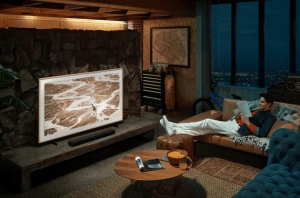
Samsung Electronics was the first to enable NFT trading on smart TVs. Early this year, Samsung Electronics announced that it would install an 'NFT Platform' application (app) on the 'Smart Hub' of its smart TV products at the World Appliance Exhibition (CES 2022).
In March, they launched smart TVs equipped with NFT trading platform functions in collaboration with the famous NFT exchange, Nifty Gateway. At the IFA 2022, the largest European international appliance fair held in Berlin, Germany, in September, they also showcased an app called ArtToken, a Samsung smart TV exclusive digital art platform. ArtToken is scheduled to be released as a Tizen app for Samsung's premium TV lineup, including Neo QLED and The Frame.
LG Electronics, one of the two pillars of the Korean appliance industry, is also introducing NFTs into smart TVs alongside Samsung Electronics. In September, it unveiled LG ArtLab, a platform for viewing and trading NFT artwork in the US. LG ArtLab is an NFT platform accessible to any owner of US LG smart TVs based on webOS 5.0, directly from the TV's home screen.
LG ArtLab operates based on Hedera, a virtual asset, and Wolipo, a cryptocurrency wallet independently developed by LG Electronics. Unlike Ethereum and Solana, Hedera is not a blockchain. Instead, it utilizes Hashgraph, a Distributed Ledger Technology (DLT), to issue NFT certificates. Because it does not follow consensus algorithms like Proof of Work (PoW) or Proof of Stake (PoS) like a blockchain, its transactions are faster and more efficient than those on a blockchain.
Users simply need to scan a QR code and use the Wolipo app to purchase NFTs on LG ArtLab. Naturally, this requires purchasing USD Coin, a stablecoin pegged to the US dollar.
Overseas, NFT artwork is evolving beyond images to include streaming NFT video clips. A representative example is 'Stream NFT,' the world's first smart TV app for NFT streaming. By using this app, developed by NFT Lab, an NFT search provider, users can search, view, and trade NFT art collections on their home TV. Currently, NFT Lab has indexed and database-ized a web catalog of over 550,000 NFT works.
To use Stream NFT, users must have an NFT Lab account and a Roku-compatible smart TV or a Roku streaming player that supports US streaming media player Roku. Then, after installing the app from the Roku Store and logging in with an Ethereum-based wallet, the customer's NFTs are automatically downloaded from the blockchain. Users can check related information, such as title, description, creation date, origin market, and final sale price, on the Stream NFT channel. Stream NFT currently operates on approximately 60 million Roku-supported TVs and supports resolutions from 720p up to 2160p 4K.
Nomad Media Club, based in Dublin, Ireland, announced the launch of the world's first NFT-based audio streaming platform last April. The company developed a Web3-based music streaming platform to discontinue subscription-based streaming and provide fairer payments to creators.
Significance for the NFT Ecosystem: New Business Opportunities and Customer Value
So, what does it mean for the NFT ecosystem and its participants that NFTs are being seriously integrated into the media field beyond just artwork?
The emergence of NFT streaming TV apps is an example of how the function of smart TVs is evolving at an industrial level. The TV is transitioning from merely a medium for watching TV programs or movies to a customer value platform where digital artworks like NFTs can be viewed and traded.
Providers can offer new customer experiences through diverse and innovative content via these TV-integrated NFT platforms, thereby retaining customers. This is because TV manufacturers know well that they cannot attract customers merely by offering premium TVs with technical completeness, such as picture quality.
In fact, TV appliance manufacturers have tried many things to provide diverse content experiences to customers. Samsung Electronics' Lifestyle TV, released in 2015, is a prime example. The Lifestyle TV is a new concept TV that allows users to view various artworks through Art Store, a dedicated subscription platform for The Frame.
Consumers now have the opportunity to receive additional rewards while watching TV. This is because NFT platforms enable a 'Watch-to-Earn' revenue model, allowing users to earn income while viewing, similar to 'Play-to-Earn' in games.
From a technical perspective, the trend of providing NFTs in audio or video formats, rather than just images, is expected to increase. Although NFTs have primarily been in the form of photos or images due to technical limitations so far, providing them in video or audio streaming formats will become common. Accordingly, video-based NFTs are expected to bring new revenue streams to the audio/video catalog sectors, including movies, entertainment, sports, and music.
Of course, solving technical challenges is necessary for this to become reality. Since NFTs are digital title deeds stored on the blockchain, the NFT itself is permanently stored, but the original digital file, such as a video, cannot be stored.
Consequently, technology startups are emerging to overcome the limitations of video NFTs. These include VideoCoin, Theta, and Audius. VideoCoin, a blockchain-based video platform, solved the storage problem by collaborating with Filecoin, a distributed storage service provider, to enable the storage of high-resolution video files.
The integration of smart TVs and NFTs is significant in terms of providing new business opportunities or customer value to numerous participants in the future NFT ecosystem. Despite the trend of NFT adoption by domestic and international TV appliance manufacturers, it is difficult to succeed by simply adding features without thorough prior planning, as shown by the case of CNN's Vault shutdown.
The NFT platforms currently available on smart TVs are still in their infancy, and a challenge that must be solved is that there are virtually no NFT artworks available to search for and purchase on smart TVs.
Nevertheless, if the purchase and sale of NFTs through smart TVs increase in the future, providing new TV experiences to customers, it is expected to be a very meaningful attempt not only for the declining NFT market but also for the media industry itself.
Sim Yong-woon, Senior Researcher at SK Management Economics Institute
© Hankyung Magazine. Reproduction and redistribution prohibited.
Source: Hankyung Magazine (https://magazine.hankyung.com ) https://magazine.hankyung.com/business/article/202210264940b